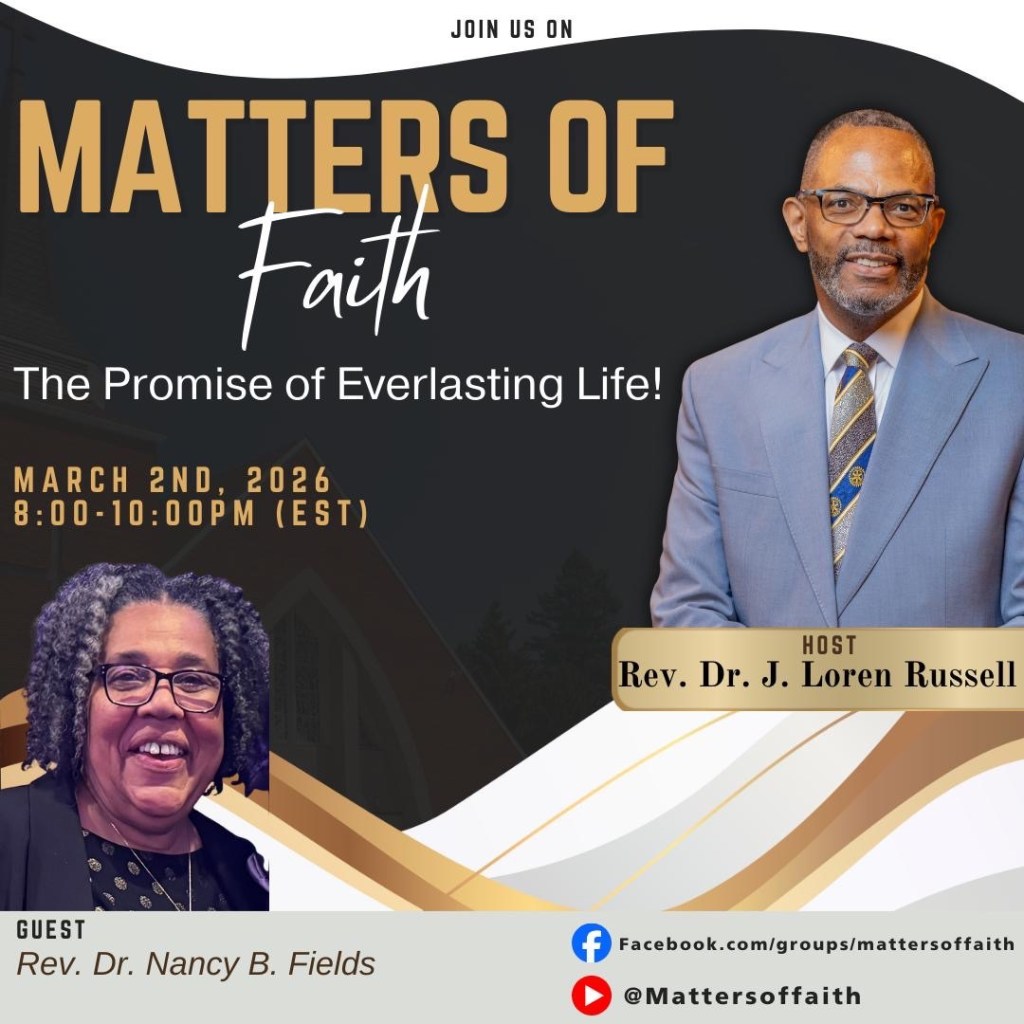
Matters of Faith

A practical application of the Word of God for everyday issues.

  • Reverend J. Loren Russell

    Isaiah 9:6-7

    For unto us a Child is born, unto us a Son is given; and the government will be upon His shoulder. And His name will be called Wonderful, Counselor, Mighty God, Everlasting Father, Prince of Peace.

    Of the increase of His government and peace there will be no end, up on the throne of David and over His kingdom, to order it and establish it with judgment and justice from that time forward, even forever.

    The zeal of the Lord of hosts will perform this. 

    We began this Advent season on Sunday, November 30th, the fourth Sunday before Christmas Day and will conclude on Christmas Eve, Wednesday December 24th. It is in anxious anticipation that we await the Advent, the “coming” or “arrival” of Jesus the Christ. 

    Christ means the anointed one, the Messiah, or divinely appointed savior or king. The name Jesus translates into Joshua, which means God saves. Jesus Christ is the divinely appointed and anointed one who saves us from the consequences of our sins. Jesus Christ is the salvation of the world because there is power in the name of Jesus!

    This is evidenced in Paul’s letter to the Philippian church (2:9-11), “Therefore God also has highly exalted Him and given Him the name which is above every name, that at the name of Jesus every knee should bow, of those in heaven, and of those on earth, and of those under the earth, and that every tongue should confess that Jesus Christ is Lord, to the glory of God the Father”. Luke further clarifies in Acts 4:12 “Nor is there salvation in any other, for there is no other name under heaven given among men by which we must be saved.” 

    The Advent not only celebrates the birth of Christ, but it symbolizes the spiritual journey of individuals and congregations. We affirm in our worship that Christ has come, that He is present in the world today, and that He will come again in power. 

    John puts in order the advent and the magnitude of Jesus’ presence when he shared Jesus’ discussion with the Apostle Thomas and then explains why he wrote at all in the final sentence; “Jesus said to him, “Thomas, because you have seen Me, you have believed. Blessed are those who have not seen and yet have believed.” And truly Jesus did many other signs in the presence of His disciples, which are not written in this book; but these are written that you may believe that Jesus is the Christ, the Son of God, and that believing you may have life in His name” (John 20:29-31). 

    The birth of Jesus brings life. His life leads to the cross. The cross gives way to the resurrection. And without the resurrection, faith has no foundation, forgiveness has no power, eternal life has no promise, and hope has no voice.

    Advent invites us into eternal gratitude, for apart from gratitude, the promise of hope cannot be received.

    Be Blessed! 

  • By Reverend J. Loren Russell

    1 Kings 17:13–16 (NLT)

    “But Elijah said to her, ‘Don’t be afraid! Go ahead and do just what you’ve said, but make a little bread for me first. Then use what’s left to prepare a meal for yourself and your son. For this is what the Lord, the God of Israel, says: There will always be flour and olive oil left in your containers until the time when the Lord sends rain and the crops grow again!’ So she did as Elijah said, and she and Elijah and her household continued to eat for many days. There was always enough flour and olive oil left in the containers, just as the Lord had promised through Elijah.”

    Proverbs 25:21–22 (NKJV)

    “If your enemy is hungry, give him bread to eat; and if he is thirsty, give him water to drink; for so you will heap coals of fire on his head, and the Lord will reward you.”

    In a world increasingly shaped by scarcity, competition, and self-preservation, scripture offers a countercultural promise that still challenges and comforts believers today: “If your enemy is hungry, give him bread to eat; and if he is thirsty, give him water to drink… and the Lord will reward you” (Proverbs 25:21–22).

    This promise is not theoretical. It is vividly embodied in the Old Testament account of the widow of Zarephath found in 1 Kings 17:13–16—a story that reveals how faith-filled generosity invites divine provision, even in the most desperate circumstances.

    The setting of 1 Kings 17 is bleak. A devastating famine grips the land, revealed by a prophetic word spoken by Elijah during the reign of King Ahab. Food supplies are exhausted, hope is thin, and survival is uncertain.

    God sends Elijah—not to a wealthy benefactor, but to a widow in Zarephath. In biblical times, widows were among the most vulnerable members of society. This woman had reached the end of her resources. She tells Elijah that she has only enough flour and oil to prepare one final meal for herself and her son before they expect to die.

    It is here, at the intersection of desperation and divine purpose, that God issues an extraordinary test of faith. Elijah’s request seems unreasonable: “Make me a little bread first.” Then, it is followed by a word of reassurance—“Do not be afraid.” 

    The widow faces a stark choice: cling to her last portion or trust the word of the Lord spoken through His prophet. In an act of remarkable obedience, she gives first—placing faith above fear and generosity above survival instincts. Her obedience unlocks a miracle.

    Scripture tells us that the flour did not run out and the oil did not fail. Day after day, God sustained that household until the rains returned. Notably, God did not provide abundance in advance. He provided enough—enough for today, enough for tomorrow, enough for as long as it was needed. 

    This pattern reflects how God often works in our lives. He supplies daily bread, inviting daily trust.

    During the Advent season of celebration and anticipation, generosity often flows easily toward family and friends. But Scripture challenges us further. The scripture from Proverbs call us to extend compassion not only to those we love, but also to those who oppose us.

    Feeding an enemy is not sentimental kindness—it is radical obedience. It is a refusal to let resentment have the final word. It is a declaration that our trust rests not in retaliation, but in God’s justice and provision.  

    The widow of Zarephath learned a lesson still true today: you cannot out-give God. The reward may not always come in material form, but it will come—in peace, provision, strength, and spiritual assurance.

    God honors faith that acts, generosity that costs, and obedience that trusts Him beyond visible resources.

    In a time marked by division, hostility, and uncertainty, believers are called to live differently; feed the hungry, give drink to the thirsty, extend grace where it is undeserved, and love where it is least expected.

    When you trust God enough to give—especially when it is difficult—you will discover that the supply never runs dry, and the Lord will reward you. 

    Be Blessed!

  • By Reverend J. Loren Russell

    Romans 5:1-5, 8 (NKJV)

    “Therefore, having been justified by faith, we have peace with God through our Lord Jesus Christ, through whom also we have access by faith into this grace in which we stand, and rejoice in hope of the glory of God. And not only that, but we also glory in tribulations, knowing that tribulation produces perseverance; and perseverance, character; and character, hope. Now hope does not disappoint, because the love of God has been poured out in our hearts by the Holy Spirit who was given to us. 

    But God demonstrates His own love toward us, in that while we were still sinners, Christ died for us.”

    One of the most well-knowns scriptures in the New Testament, if not the entire Bible is John 3:16, “For God so loved the world that He gave His only begotten Son, that whosoever believes in Him should not perish but have everlasting life.” It is even more significant during this season of Advent, the time leading up to the universal celebration of the birth of “His only begotten Son.”

    Advent (coming) is officially observed over the four Sundays leading up to the perfect gift of love given on Christmas day, the birth of our Lord and Savior Jesus Christ. One candle is lit on each of those four Sundays. 

    1. Hope – To remind us that God keeps His promises. He promised a Savior, and He sent one.

    2. Preparation – Reminds us to be prepared to receive the Lord. 

    3. Joy – Reminds us to remember the multitudes of angels that joyfully announced the birth of Christ.

    4. Love – Reminds us that it was out of His incredible love that God sent His only begotten Son.

    There is one more candle, the Christ Candle, traditionally lit on Christmas Eve to remind us that “the love of God has been poured out in our hearts by the Holy Spirit who was given to us” (Romans 5:5). All who believe are its recipients.

    This perfect gift from God assures believers that the pressures and problems of life do not have the final word, because God intended this gift for us. Advent reminds us of the birth of His only begotten Son—a gift given to secure eternal life for all who believe. It is God’s bold announcement to the world that in Christ we receive the perseverance that molds our character and strengthens our hope. And this is our confidence: the perfect gift of God’s love conquers hatred, overturns unjust powers, heals our brokenness, and stands victorious over every human crisis. 

    As we enter this season of giving, let us also be generous in offering what God has given to us. Someone’s eternal life may hang in the balance.

    Be Blessed!

  • Reverend J. Loren Russell

    John 11:38-45 (NKJV)

    Then Jesus, again groaning in Himself, came to the tomb. It was a cave, and a stone lay against it. Jesus said, “Take away the stone.” Martha, the sister of him who was dead, said to Him, “Lord, by this time there is a stench, for he has been dead four days.” Jesus said to her, “Did I not say to you that if you would believe you would see the glory of God?” Then they took away the stone from the place where the dead man was lying. And Jesus lifted up His eyes and said, “Father, I thank You that You have heard Me. And I know that You always hear Me, but because of the people who are standing by I said this, that they may believe that You sent Me.” Now when He had said these things, He cried with a loud voice, “Lazarus, come forth!” And he who had died came out bound hand and foot with graveclothes, and his face was wrapped with a cloth. Jesus said to them, “Loose him, and let him go.” Then many of the Jews who had come to Mary, and had seen the things Jesus did, believed in Him.

    Sometimes it’s necessary to get over the stench to help someone. The story of Lazarus challenges the reader in many ways, particularly when it comes to obeying the command of Christ to remove the stone and then loose him by taking off his grave clothes. 

    The embalming methods used in those days did little to reduce the decomposition of the body. After four days of warm and humid Mediterranean weather, the stench and decay of a dead body would have been overwhelming. Martha’s response to Jesus, “Lord, by this time there is a stench” –is understandable. The smell of a dead body can be overpowering, and touching the dead defiled the Jew, making them ceremonially unclean and unable to enter the temple. Sometimes, our senses and our traditions can paralyze us and prevent us from participating in the transformational miracles of the Lord.  

    But this was no ordinary day, and these were transformational commands. Jesus invites those who were present to go beyond their human senses and Jewish traditions. 

    When we see people who need our help, we are often challenged-just like those at the grave site-to get over the stench. When Jesus commanded them to remove the stone, he was saying, “There is a man who needs your help. Get over the stench!” When He commands them to “Loose him, and let him go,” He was saying get over the stench of death and the fear of uncleanness. People need compassion and a human touch. If we are unwilling because of their smell, their appearance, their behavior, or concerned about the way we may look to society, the blessing the Lord has for them will be delayed. Let me be clear, it won’t be stopped- just delayed until the Lord finds someone who is willing to get over the stench.

    Jesus miraculously called Lazarus from the grave, but it was left to the people to remove the stone and the grave clothes. If we can get over the stench, we too can participate in the miracle of helping others become like many of the Jews who had come to Mary and, having seen the things Jesus did, believed in Him.

    Get over the stench!

    Be Blessed!

  • Such As I Have

    Reverend J. Loren Russell

    Acts 3:1-6 (KJV)

    “Now Peter and John went up together into the temple at the hour of prayer, being the ninth hour. 2 And a certain man lame from his mother’s womb was carried, whom they laid daily at the gate of the temple which is called Beautiful, to ask alms of them that entered into the temple;3 Who seeing Peter and John about to go into the temple asked an alms. 4 And Peter, fastening his eyes upon him with John, said, Look on us. 5 And he gave heed unto them, expecting to receive something of them. 6 Then Peter said, Silver and gold have I none; but such as I have give I thee: In the name of Jesus Christ of Nazareth rise up and walk.”

    In the same way you can’t give what you never had, you cannot come back from where you have never been. These idioms are not just wise sayings; they are truths that will never change. So is the statement made by Peter when he told the lame man, “such as I have!”

    Recognizing our limitations does not limit our abilities, it improves it. Neither Peter nor John had any money to give to the lame man begging for charity. That was their limitation. At one time, they may have had an abundance of resources that they could have shared with this poor beggar, but they had given up their businesses, discarded their material possessions, and committed themselves to following Jesus. They had nothing material to give this man. But what they did have they were willing to share.

    As they were entering the temple at the hour of prayer, Peter and John  are confronted by someone whose only hope of survival was the generosity of those who were committed to God. Having no medical benefits, no social security, no pension benefits, he was daily laid at the temple gate called beautiful to beg – this man with a heart-felt plea for help. Peter and John recognized their limitations but were more than willing to share what they did have with this man. The lame man was begging for charity, what he got was a miracle. “Look on us…, Silver and gold have I none; but such as I have give I thee: In the name of Jesus Christ of Nazareth rise up and walk.”

    What the lame man thought he would receive turned into a change in his life that would take him places he never thought he would go, and to do things he never thought he would do. Immediately after Peter shared what he had, the scripture says, “he took him by the right hand, and lifted him up: and immediately his feet and ankle bones received strength. And he leaping up stood, and walked, and entered with them into the temple, walking, and leaping, and praising God.”

    What has God gifted you with? What are you willing to share with someone seeking alms that will transform their lives forever? Are you willing to say, “Such as I have, give I thee…”

    Be Blessed!